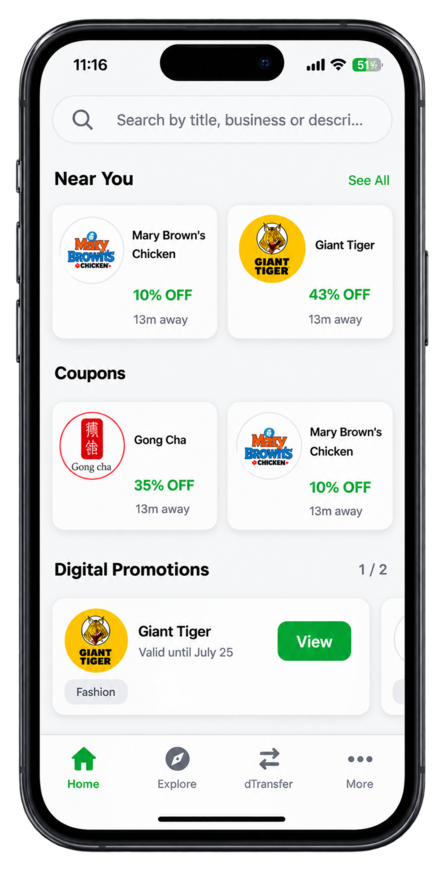
What QSR Marketing Strategies Actually Work for Canadian Restaurants in 2025?

Quick-service restaurants operate in one of the most competitive markets in Canada.
Margins are tight.
Customer loyalty can be fragile.
Foot traffic is never guaranteed.
For QSR operators in Edmonton, Alberta, and across Canada, traditional flyers and print promotions are losing impact because customers have moved online.
Customers now use their phones to:
- Search for restaurants nearby
- Compare meal options
- Check reviews
- Look for deals
- Redeem digital coupons
- Order ahead
- Decide where to eat next
That is why QSR marketing strategies need to be mobile-first, local, measurable, and easy for customers to act on.
Digital coupons are one of the strongest tools for quick-service restaurants because they help restaurants reach customers quickly, promote offers clearly, and track redemptions.
Angel-Earth Corporation helps Canadian restaurant operators do this through its Digital Coupons product, built specifically for the quick-service industry.
This guide explains which QSR marketing strategies work, why digital coupons matter, and how restaurants can use Angel-Earth Digital Coupons and Radius Push Notifications to drive more orders in 2025.
What Are QSR Marketing Strategies?
QSR marketing strategies are promotional tactics that quick-service restaurants use to attract customers, increase orders, and encourage repeat visits.
These strategies can include:
- Digital coupons
- Mobile offers
- Radius push notifications
- 1-Day Campaigns
- Lunch specials
- Combo deals
- Loyalty offers
- Limited-time menu promotions
- New customer incentives
- Repeat customer campaigns
- Hyperlocal advertising
The best QSR marketing strategies are simple, fast, and easy to redeem.
Quick-service customers usually make decisions quickly.
They want:
- Value
- Convenience
- Speed
- Clear offers
- Easy redemption
- Relevant timing
That means QSR campaigns need to reach customers at the right moment with an offer they can understand immediately.
Why Do QSR Marketing Strategies Matter More Than Ever?
QSR marketing strategies matter because restaurant competition is intense.
Customers have many options for:
- Coffee
- Lunch
- Dinner
- Snacks
- Takeout
- Fast casual meals
- Quick-service combos
- Delivery app orders
If a restaurant does not stay visible, customers may choose a nearby competitor.
Digital marketing has also changed customer expectations.
Customers now expect:
- Instant deals
- Mobile-friendly offers
- Simple redemption
- Personalized promotions
- Location-relevant coupons
- Fast ordering and checkout
- Offers that match their timing
For QSR operators in Edmonton and Alberta, strong QSR marketing strategies can directly impact foot traffic, order frequency, and customer retention.
The restaurants that win are not always the ones spending the most.
They are often the ones reaching the right customers at the right time with the clearest offer.
Why Are Traditional Flyers Less Effective for QSR Marketing Strategies?
Traditional flyers can still create awareness, but they are not always the best fit for modern QSR marketing strategies.
Flyers can be:
- Expensive to print
- Slow to distribute
- Hard to update
- Easy to ignore
- Difficult to track
- Wasteful when unused
- Broadly targeted
- Disconnected from mobile behaviour
For quick-service restaurants, this is a problem.
Food decisions often happen quickly.
A customer may decide where to eat:
- During a lunch break
- While walking nearby
- Before driving home
- During a shopping trip
- After seeing a same-day offer
- While comparing nearby restaurants on a phone
A flyer delivered days earlier may not influence that decision.
Digital coupons and push notifications can reach customers much closer to the decision moment.
That makes them more practical for QSR marketing strategies focused on immediate action.
How Do Digital Coupons Fit Into QSR Marketing Strategies?
Digital coupons are one of the most useful QSR marketing strategies because they combine value, timing, and tracking.
A digital coupon can help a restaurant:
- Promote a lunch offer
- Drive traffic during slow periods
- Increase average order value
- Encourage repeat visits
- Reward loyal customers
- Introduce a new menu item
- Attract first-time customers
- Track campaign performance
Digital coupons are not just discounts.
They are tools that shape customer behaviour.
For example:
- A free drink upgrade can increase perceived value.
- A combo discount can increase order size.
- A first-time customer coupon can reduce hesitation.
- A limited-time lunch offer can drive same-day visits.
- A returning customer coupon can encourage repeat orders.
Angel-Earth Digital Coupons give QSR operators a simple way to publish, distribute, and track these campaigns without expensive software or agency fees.
Why Are Digital Coupons Stronger Than Generic Discounts?
Generic discounts can be useful, but they are often too broad.
A general discount may not explain:
- Who the offer is for
- When the offer expires
- Which customer action is expected
- Whether the campaign worked
- Which audience responded
- Whether the offer protected margins
Digital coupons give restaurants more control.
A restaurant can create different offers for different goals.
For example:
- A lunch coupon for weekday traffic
- A dinner coupon for slower evenings
- A first-time customer offer for acquisition
- A returning customer offer for loyalty
- A new menu item coupon for product promotion
- A short-term coupon for urgency
This makes digital coupons more strategic than general discounts.
For QSR marketing strategies, the goal is not just to discount.
The goal is to create measurable customer action.
What Are the Main Benefits of Digital Coupons for QSR Operators?
Digital coupons offer several benefits for quick-service restaurants.
The main benefits include:
- Immediate reach
- Lower customer acquisition costs
- Measurable performance
- Flexible campaign timing
- Reduced paper waste
- Hyperlocal targeting
- Better repeat visit opportunities
- Stronger customer engagement
These benefits matter because QSR operators need campaigns that are practical, fast, and easy to evaluate.
Digital coupons help restaurants avoid guessing and start learning what actually drives orders.
How Do Digital Coupons Give Restaurants Immediate Reach?
Digital coupons can reach customers quickly.
There is no need to wait for:
- Print runs
- Flyer delivery
- Postal distribution
- Physical coupon pickup
- New menus or signs
- Long campaign setup
A restaurant can create a digital coupon and distribute it through channels like:
- Push notifications
- Digital coupon platforms
- Social media
- In-app messages
- Restaurant websites
- Local digital promotions
For QSR marketing strategies, speed matters.
A restaurant may need to promote:
- A lunch deal today
- A new combo this weekend
- A slow Tuesday offer
- A dinner special before 5 PM
- A limited-time menu item
Digital coupons allow restaurants to act faster than print.
How Can Digital Coupons Lower Customer Acquisition Costs?
Customer acquisition can be expensive for restaurants.
Traditional advertising may require spending on:
- Flyers
- Print ads
- Social media ads
- Radio spots
- Delivery app promotions
- Agency fees
- Graphic design
- Broad local campaigns
Digital coupons can reduce wasted spend because they are targeted and measurable.
Instead of paying to reach a broad audience, QSR operators can create offers for specific customer groups.
For example:
- Nearby lunch customers
- New customers in the area
- Existing customers who have not visited recently
- Customers near a store during a slow period
- People within a set radius of the restaurant
When paired with Radius Push Notifications, digital coupons can reach customers close enough to visit.
This makes QSR marketing strategies more efficient because the campaign focuses on people who can actually act.
How Do Digital Coupons Make QSR Marketing Strategies More Measurable?
Measurement is one of the biggest advantages of digital coupons.
Print coupons are harder to track.
A restaurant may not know:
- How many people saw the flyer
- How many flyers were thrown away
- Which neighbourhood responded
- Whether the campaign drove new customers
- Whether customers returned later
- Which offer performed best
Digital coupons give restaurants more campaign data.
Restaurants can track:
- Coupon views
- Clicks
- Redemptions
- Redemption rate
- Offer performance
- Customer response
- Timing performance
- Revenue during the campaign
- Repeat customer activity
This helps QSR operators improve future campaigns.
For example:
- A restaurant may learn lunch coupons outperform dinner coupons.
- A QSR may discover combo offers work better than percentage discounts.
- A café may find morning coupons drive more action than afternoon coupons.
- A restaurant may learn that a smaller radius performs better than a wider one.
Strong QSR marketing strategies are built on data, not guessing.
How Do Digital Coupons Give Restaurants More Flexibility?
Digital coupons are flexible because they can be changed, tested, and adjusted faster than print promotions.
Restaurants can use digital coupons for:
- Same-day offers
- 1-Day Campaigns
- Weekend specials
- Lunch promotions
- Dinner offers
- New menu item launches
- Seasonal campaigns
- Returning customer rewards
- First-time customer offers
This flexibility matters in QSR marketing because restaurant demand can change quickly.
For example:
- A rainy day may reduce foot traffic.
- A local event may create sudden demand.
- A slow weekday may need a traffic boost.
- A new menu item may need promotion.
- A competitor may launch an offer nearby.
- A restaurant may need to move inventory before it expires.
Digital coupons help restaurants respond quickly.
How Do Digital Coupons Reduce Paper Waste?
Digital coupons reduce the need for printed promotional materials.
That means restaurants can avoid or reduce:
- Paper coupons
- Flyer distribution
- Printed discount cards
- Paper inserts
- Reprint waste
- Unused printed materials
This supports more eco-friendly QSR marketing strategies.
Customers increasingly notice when businesses use more sustainable practices.
Digital coupons can help restaurants show that they are moving away from wasteful print promotions and toward cleaner digital tools.
This also helps reduce costs connected to printing, storage, and distribution.
How Does Hyperlocal Targeting Improve QSR Marketing Strategies?
Hyperlocal targeting helps restaurants reach customers close enough to visit.
This is important because QSR decisions are often location-based.
A customer nearby may act quickly.
A customer far away may ignore the offer.
Angel-Earth Radius Push Notifications allow restaurants to reach customers within a selected radius of their location.
This can help restaurants target:
- Nearby workers
- Lunch traffic
- Local residents
- Event attendees
- Weekend shoppers
- Dinner traffic
- Customers close to the restaurant
- Customers within walking or driving distance
Hyperlocal targeting makes QSR marketing strategies more practical because the campaign reaches people who are most likely to become customers.
How Can QSR Operators Launch a Digital Coupon Campaign?
QSR operators can launch a digital coupon campaign by following a simple process.
The main steps include:
- Define the campaign goal.
- Choose the right offer.
- Set the target audience.
- Set the campaign duration.
- Publish and distribute the coupon.
- Pair the campaign with Radius Push Notifications.
- Track redemptions.
- Adjust future campaigns.
Each step helps the restaurant keep the campaign focused and measurable.
How Should QSR Operators Define the Campaign Goal?
The first step is deciding what the campaign should accomplish.
Common QSR campaign goals include:
- Increase lunch traffic
- Boost dinner sales
- Drive repeat visits
- Promote a new menu item
- Increase average order value
- Attract first-time customers
- Fill slow weekday periods
- Promote a limited-time combo
- Improve customer retention
The goal should guide the offer.
For example:
- If the goal is lunch traffic, the coupon should be timed before lunch.
- If the goal is higher average order value, the coupon may use a bundle or combo offer.
- If the goal is repeat visits, the coupon may target returning customers.
- If the goal is customer acquisition, the coupon may offer a first-time customer incentive.
QSR marketing strategies work best when the goal is specific.
How Should QSR Operators Choose the Right Offer?
A strong QSR coupon offer should be simple and easy to understand.
Customers should know the value within seconds.
Strong QSR coupon offers include:
- Buy one, get one free on select items
- Percentage discount on a combo meal
- Free item with minimum purchase
- Limited-time price reduction
- Free drink upgrade
- Add a side for $1
- $5 off orders over $30
- First-time customer discount
- Returning customer offer
The best offer depends on the restaurant’s goal and margins.
Restaurants should avoid offers that are too complicated or too deep.
A strong coupon should motivate action while still protecting profitability.
How Should QSR Operators Set the Target Audience?
The target audience should match the campaign goal.
Possible QSR audiences include:
- Nearby customers
- Lunch customers
- Dinner customers
- First-time customers
- Existing customers
- Lapsed customers
- Loyal regulars
- Local workers
- Weekend shoppers
- Customers near an event
Different audiences need different offers.
For example:
- New customers may need a welcome offer.
- Existing customers may respond to loyalty coupons.
- Nearby workers may respond to lunch deals.
- Lapsed customers may need a stronger comeback offer.
- Event attendees may respond to a same-day promotion.
QSR marketing strategies perform better when the campaign speaks to a specific customer group.
Why Should QSR Campaigns Use Shorter Durations?
Shorter campaigns often create stronger urgency.
A month-long coupon may be easy to ignore.
A short campaign gives customers a clearer reason to act.
Useful QSR campaign windows include:
- Same-day offers
- 1-Day Campaigns
- Lunch-only offers
- Dinner-only offers
- Weekend promotions
- 3-day campaigns
- 7-day campaigns
For example:
- A lunch coupon can expire at 2 PM.
- A dinner coupon can expire at close.
- A weekend coupon can run Friday to Sunday.
- A 1-Day Campaign can create urgency around one major offer.
Shorter campaign windows are often stronger for QSR marketing strategies because they match fast customer decision cycles.
How Should QSR Operators Distribute Digital Coupons?
A coupon only works if customers see it.
QSR operators can distribute digital coupons through:
- Angel-Earth Digital Coupons
- Radius Push Notifications
- SMS
- Social media
- Website banners
- In-app messages
- Customer loyalty messages
- In-store signage
Radius Push Notifications are especially useful because they can alert nearby customers instantly.
For example:
- A lunch coupon can be sent before noon.
- A dinner offer can be sent in the afternoon.
- A café deal can be sent before morning traffic.
- A limited-time combo can be sent during a slow period.
QSR marketing strategies are stronger when the distribution channel matches the customer’s decision moment.
How Can Radius Push Notifications Support QSR Marketing Strategies?
Radius Push Notifications support QSR marketing strategies by helping restaurants reach customers nearby.
Angel-Earth Radius Push Notifications allow restaurants to send a message to customers within a selected radius.
This is useful because restaurant decisions are often made close to the restaurant.
A Radius Push Notification can promote:
- Digital coupons
- Lunch specials
- Dinner offers
- New menu items
- Limited-time combos
- 1-Day Campaigns
- Slow-period offers
- Returning customer deals
For example:
- A QSR can send a lunch offer to customers within a few kilometres.
- A café can send a coffee coupon in the morning.
- A restaurant can promote a dinner special before the evening rush.
- A dessert shop can promote a treat deal after dinner.
When paired with digital coupons, Radius Push Notifications create a more direct path from offer to visit.
How Should QSR Operators Track Redemptions?
Tracking redemptions helps restaurants understand campaign performance.
QSR operators should review:
- Coupon views
- Coupon clicks
- Redemptions
- Redemption rate
- Average order value
- Revenue during the campaign
- New customer visits
- Repeat customer activity
- Time of day performance
- Offer performance
After the campaign, operators should ask:
- Did the coupon drive orders?
- Did the timing work?
- Was the offer strong enough?
- Did the campaign protect margins?
- Did it bring in new customers?
- Did customers return later?
- Should the offer be repeated or adjusted?
Tracking is essential for improving QSR marketing strategies over time.
What Mistakes Do QSR Operators Make With Digital Promotions?
Digital promotions can work well, but restaurants need to avoid common mistakes.
Common mistakes include:
- Offering too much discount
- Running campaigns without a goal
- Ignoring timing
- Using complicated redemption processes
- Skipping hyperlocal targeting
- Not tracking results
- Sending offers too frequently
- Using vague coupon messaging
These mistakes can reduce performance and hurt margins.
A strong campaign should be clear, timely, targeted, and easy to redeem.
Why Is Offering Too Much Discount a Mistake?
Deep discounts can bring in customers, but they can also hurt margins.
Restaurants should calculate the cost of each offer.
They should consider:
- Food cost
- Labour cost
- Average order value
- Add-on potential
- Repeat visit potential
- Expected redemption volume
- Profit margin
A 5% or 10% discount may sometimes perform well while protecting the bottom line.
Restaurants do not always need heavy discounts.
Other offers can work too, such as:
- Free drink upgrade
- Free side with purchase
- Combo bundle
- Limited-time add-on
- First-time customer bonus
QSR marketing strategies should drive traffic without weakening the business financially.
Why Is Running Campaigns Without a Goal a Mistake?
Random promotions produce random results.
A campaign should have a clear objective before launch.
Without a goal, the restaurant may not know:
- Which offer to use
- Which audience to target
- When to send the campaign
- How long the campaign should run
- How success should be measured
A clear goal makes every other decision easier.
For example:
- A slow lunch campaign should focus on lunch timing.
- A repeat visit campaign should target existing customers.
- A new menu campaign should feature a specific product.
- A first-time customer campaign should reduce trial hesitation.
Strong QSR marketing strategies start with a clear campaign goal.
Why Does Timing Matter in QSR Marketing Strategies?
Timing matters because food decisions happen at specific moments.
A coupon sent at the wrong time may be ignored.
For example:
- A lunch coupon sent at 10 PM is wasted.
- A dinner coupon sent after dinner may be too late.
- A breakfast offer sent in the afternoon is irrelevant.
- A same-day offer sent near closing may not give customers time to act.
QSR operators should time campaigns around customer decision windows.
Good timing examples include:
- Morning for coffee or breakfast offers
- Late morning for lunch deals
- Afternoon for dinner offers
- Late afternoon for after-work traffic
- Evening for dessert or snack promotions
The best QSR marketing strategies reach customers before they decide where to eat.
Why Should Coupon Redemption Be Simple?
QSR customers expect speed.
If coupon redemption is complicated, customers may abandon the offer.
Restaurants should avoid:
- Long instructions
- Too many restrictions
- Hard-to-enter codes
- Confusing terms
- Staff confusion
- Slow checkout processes
- Multi-step redemption flows
A strong digital coupon should be:
- Easy to show
- Easy to scan or enter
- Easy for staff to understand
- Clear about expiry
- Clear about eligible items
- Fast to redeem
Simple redemption is especially important in quick-service environments where speed matters.
Why Should QSR Operators Use Hyperlocal Targeting?
Hyperlocal targeting reduces wasted reach.
A customer 20 kilometres away may not visit for a lunch deal.
A customer nearby may act immediately.
Restaurants should focus campaigns on people who can realistically visit.
This may include:
- Customers within walking distance
- Customers near offices
- Customers near schools
- Customers near shopping areas
- Customers near event venues
- Customers within a realistic driving radius
Angel-Earth Radius Push Notifications help QSR operators focus on nearby customers.
That makes QSR marketing strategies more efficient and more relevant.
Why Is Tracking Results Essential?
If a restaurant does not track results, it cannot improve.
Tracking helps restaurants learn:
- Which offers work best
- Which times perform best
- Which audiences respond
- Which coupons protect margins
- Which campaigns drive repeat visits
- Which channels create redemptions
Without tracking, the restaurant may keep repeating weak campaigns.
With tracking, each campaign becomes a learning opportunity.
Angel-Earth Digital Coupons include redemption tracking so QSR operators can see what is working and adjust future campaigns.
How Do Print Coupons Compare to Digital Coupons for QSR Marketing Strategies?
Print coupons and digital coupons work very differently.
Print coupons can be:
- Slow to distribute
- Expensive to print
- Hard to track
- Difficult to update
- Wasteful
- Easy for customers to lose
- Less connected to mobile behaviour
Digital coupons can be:
- Launched quickly
- Tracked in real time
- Updated more easily
- Sent to mobile devices
- Paired with push notifications
- Targeted to nearby customers
- Measured after each campaign
For QSR marketing strategies, digital coupons are often more practical because they are faster, more measurable, and better aligned with how customers make food decisions today.
What QSR Marketing Strategies Should Restaurants Use in 2025?
Restaurants should focus on QSR marketing strategies that are mobile-first, local, and measurable.
Useful strategies include:
- Digital coupon campaigns
- Radius Push Notifications
- Short-term offers
- 1-Day Campaigns
- First-time customer coupons
- Repeat visit offers
- Lunch and dinner promotions
- New menu item campaigns
- Hyperlocal targeting
- Redemption tracking
The strongest strategies usually combine timing, location, and value.
For example:
- A lunch coupon sent before noon to nearby customers
- A dinner combo promoted before the evening rush
- A same-day offer sent through a Radius Push Notification
- A new menu item coupon targeted to existing customers
- A 1-Day Campaign built around a simple offer
These QSR marketing strategies work because they match real customer behaviour.
How Can Angel-Earth Help With QSR Marketing Strategies?
Angel-Earth Corporation helps Canadian QSR operators run digital coupon campaigns built for local restaurant growth.
Angel-Earth Digital Coupons can help restaurants:
- Create digital offers
- Launch campaigns quickly
- Track redemptions
- Reduce reliance on print coupons
- Promote mobile-first offers
- Reach nearby customers
- Pair coupons with Radius Push Notifications
- Improve campaign performance over time
Angel-Earth is built for Canadian businesses, including quick-service restaurants in Edmonton, Alberta, and across Canada.
The platform gives QSR operators practical tools without the complexity or cost of enterprise marketing systems.
How Can QSR Operators Get Started With Digital Coupons?
QSR operators can start with one simple campaign.
The process can look like this:
- Choose one business goal.
- Create one clear coupon offer.
- Set one campaign window.
- Choose one target audience.
- Pair the coupon with Radius Push Notifications.
- Track redemptions.
- Review results.
- Improve the next campaign.
The first campaign does not need to be complicated.
For example:
- A QSR can test a lunch combo offer.
- A café can test a morning drink coupon.
- A restaurant can test a dinner deal.
- A dessert shop can test an evening offer.
- A fast food location can test a first-time customer coupon.
QSR marketing strategies improve when operators test, measure, and refine.
Ready to drive more orders to your QSR?
Visit Angel–Earth to learn how Angel-Earth Digital Coupons can help your restaurant reach hungry customers nearby and launch measurable campaigns.
What Sources Were Referenced in This Article?
Statistics Canada:
https://www.statcan.gc.ca
Government of Canada:
https://www.canada.ca
Angel-Earth Corporation:
https://www.angel-earth.ca
Ashutosh Kaushik
Content StrategistTrending Now
Most Popular
Ready to Transform?
Get started with our premium services and pricing plans designed for your success.